From Newsroom to Novelist, with Neal Lipschutz
“Even people who have been writing fiction for a long time feel that from book to book they have a lot to learn.”— Neal Lipschutz
About This Episode
Neal Lipschutz grew up in Brooklyn as a big reader with a strong urge to write, and as a teenager he fell in love with the New York newspapers. Practicality won out: he spent more than four decades in journalism, first as a reporter and then mostly as an editor, including a stint as deputy editor-in-chief of The Wall Street Journal. Only after retiring did he take up fiction full-time, treating it as a new job he showed up for every day. Neal talks with Mike about which newsroom habits carried over to fiction and which he had to unlearn, what it felt like to be on the other side of the editor's desk, and why he finished his first novel before looking for a publisher. He also introduces Long Arm of the Past, the sequel to his debut No Write Way to Die. In it, management consultant Scott Morgan investigates the suspicious death of his firm's former chairman, and his partner is the retired NYPD detective who was his antagonist in book one. Along the way, the secrets Scott buried in the first book start working their way back to the surface.
Key Takeaways
- The clarity that journalism demands carries straight over to fiction. Decades of making copy clear, precise and accurate gave Neal skills he uses on every page. In his view, even great fiction is often simple and fairly straightforward.
- Former journalists have to give themselves permission to let go. A clean, clear sentence isn't always enough in a novel. Neal pushes himself to get into his characters' heads and to allow some flourish in key descriptions, without overdoing it.
- Be the writer you would want to edit. After editing other people's work for a living, Neal went into his own edits determined to be open-minded and cooperative, as a novice with a lot to learn. Even small conventions, like how quotes and paragraphs are set up, work differently in a novel than in a newspaper.
- Developmental edits are a conversation, not an order. Feedback on plot or character is a free lesson, not an attack. Most editors will hear you out if you disagree, as long as you make your case.
- Finish the book before you go looking for a publisher. Neal wrote No Write Way to Die in full before approaching anyone. For him, making the manuscript as strong as possible was "job one," and the search for a publisher came after.
- Every book in a series should stand on its own. Neal wants a reader who starts with book two to understand everything and enjoy it. That means referring to what happened earlier without spoiling book one for anyone who goes back to read it.
- Place shapes character. Scott Morgan's affluent Westchester suburb is only a few miles from the Brooklyn neighborhood he grew up in, but in Neal's words the psychic distance is huge. New York and its surroundings drive both the crimes and the people in the series.
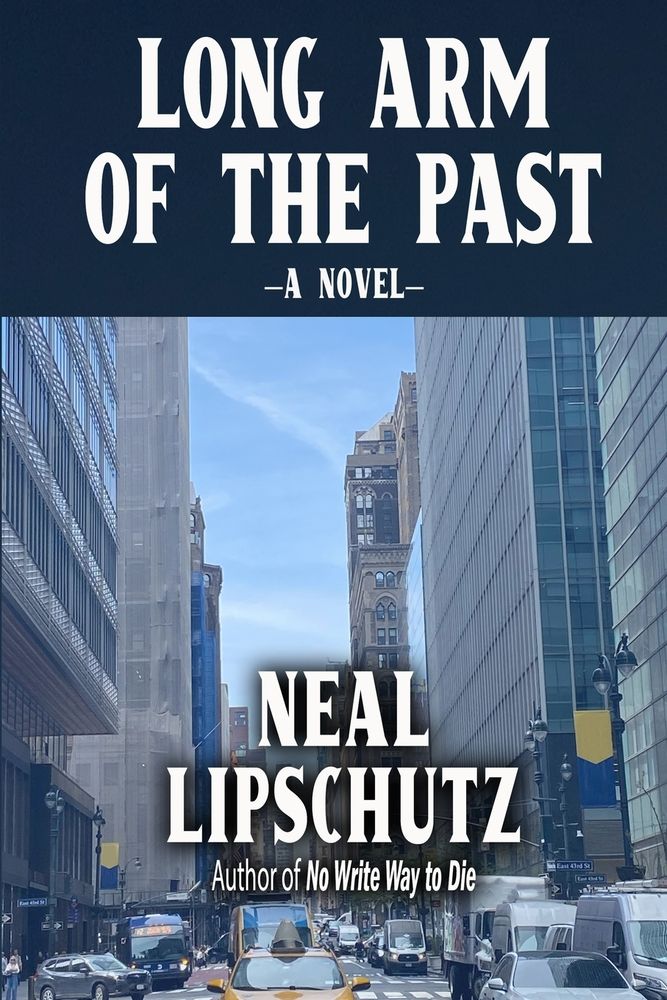
Get the Book: Long Arm of the Past
Support your local indie bookstore — if it's not on the shelf, ask them to order it.
Connect with Neal
- Website: neallipschutz.com
- Instagram: @nlipschutz
- TikTok: @neal2841
- Twitter/X: @NLipschutz
- LinkedIn: Neal Lipschutz
More conversations
The Answer 500 Authors Keep Giving
For the 500th episode, Mike Carlon turns the mic on himself: where writing careers begin, why there are no overnight successes, grief, and the 3 a.m. download that became The Waiting Room.
Listen →
Bouncing Back
Ellen Holtzman on her award-winning debut Bouncing Back, teaching herself to write, why you can't tell the story while you're still in the wound, and how women lose and find themselves in marriage and divorce.
Listen →
We're Our Own Worst Enemy
Sal Amato on his debut political sci-fi thriller Hidden Powers: Disclosure From Within, the alleged 1954 Eisenhower UFO meeting, tribalism and algorithms, and how Second City improv shaped his writing.
Listen →