About This Episode
Zara Marielle was the kind of introverted kid who wrote plays and then talked everyone she knew into performing them. She'll tell you those plays were bad. What stuck was the impulse. After undergrad she cycled through three barista jobs and a stint as an assistant talent agent for film and TV in San Francisco — a job that sounded cooler on paper than it felt in the chair — before deciding she could be writing in Scotland instead, and going.
A one-year master's at the University of Edinburgh gave her twelve months with no excuse not to write, and she has arranged her life around the work ever since, including working half time so the afternoons stayed hers.
In this conversation, Zara and Mike talk about her debut, an empowering portal fantasy about a trapped housewife who takes a secret job in a magical cafe; how the eclectic cafe she grew up above became the one in the book; why improv made her braver on the page and off it; and her conviction — formed watching ESL students insist they weren't creative — that the capacity is in everyone and only needs the will to nurture it.
Key Takeaways
- Creativity isn't a gift you're issued at birth. Zara doesn't believe some people are simply good at it and others aren't. What separates people is the willingness to work: "all it takes is to want to do it and you're halfway there already." And the work never finishes — there's no point where you've reached peak ability and can stop.
- Her debut is the third novel she finished. The first she never even queried; she just needed to prove to herself she could complete a book. The second she queried, and it went nowhere. The third got the deal. Her own verdict on showing that first manuscript to friends and family: "always be improving is the moral there."
- Braided storylines keep a draft moving. Zara writes multiple interwoven strands on purpose. When one stalls she hops to another, and the stuck one untangles itself in the background while she's away. It also gives her an outlet for backstory that would otherwise swamp the main line.
- "Strong female character" can mean starting small and claiming your power. She has a complicated relationship with the term. A sword-swinging badass is fun, but she's more interested in the relatable arc — a woman "blooming into herself." She also notes the odd double standard she runs into: readers flinch at a story about a toxic marriage, then happily read about murder.
- Improv teaches you that people will say yes. Built on "yes, and," it forces everyone to get on board with your idea rather than shoot it down — which is transformative if you grew up shy and braced for people to think your ideas were dumb. It shows up in her drafting too: she resists locking a plot's trajectory, because the unexplored direction might be the better one.
- Life becomes material, usually without asking. The magical cafe borrows from her parents' cafe, the one she grew up in a loft above, strange instruments on the walls and strangers wandering up for a box of chai. The protagonist's escape from a controlling marriage draws on a relationship Zara got out of. Scotland arrived because it was simply sitting in her subconscious, waiting to be used.
- A book deal is a beginning, not an arrival. Her agent ended their relationship twenty-four hours after the publisher contract was signed, leaving her to navigate seven months with an editor and no advocate. Because you can't query a project that already has a deal, getting new representation meant rewriting an entirely different novel from scratch. The naive notion that one deal sets you up for life, she says, is just that.
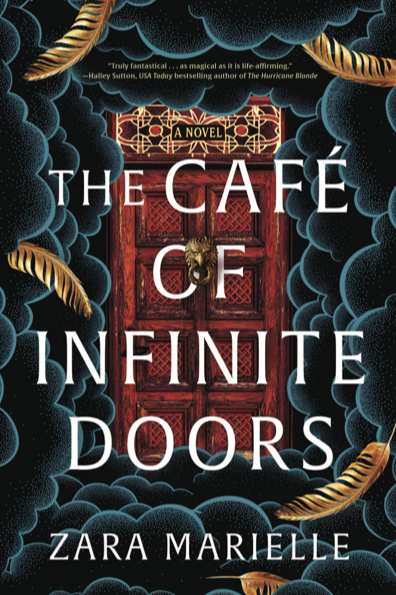
The Cafe of Infinite Doors
An empowering portal fantasy about a trapped housewife who takes a secret job in a magical cafe — and is drawn into an ancient rivalry between two Scottish goddesses, where she must finally choose herself.